PFAS Pesticides: Frequently Asked Questions
What are PFAS?
PFAS, aka forever chemicals, are a large group of manmade chemicals called perfluoroalkyl and polyfluoroalkyl substances. Some of the most persistent manmade compounds on the planet, they’re commonly used for their grease-, stain-, and water-resistant properties, but they’re also active ingredients in a long list of pesticides — including pesticides sprayed on people’s food. There are tens of thousands of different PFAS chemicals, and most lack any study at all about their harms to humans and the environment.
Are PFAS pesticides actually PFAS?
Yes.
The EPA has stated in press materials that many fluorinated pesticides aren’t PFAS. While it’s true that many don’t meet the chemicals office’s regulatory PFAS definition, they do meet the Organisation for Economic Co-operation and Development’s (OECD) PFAS definition, which was developed transparently by dozens of scientists around the world, has subsequently been endorsed by more than 150 leading PFAS researchers and used by nearly every U.S. state for regulating PFAS, and was specifically written into past versions of the National Defense Authorization Act. Using the scientific definition of a PFAS that’s widely accepted in the United States and around the world, many fluorinated pesticides are PFAS.
The EPA has also stated that its PFAS definition specifically excluded chemicals that had a single fully fluorinated carbon because they don’t display the persistence properties commonly associated with forever chemicals. The agency’s final rule for its PFAS definition cites a single study to support this assertion (Gaines et al, 2023). But the only instance where this study mentions the lack of persistence of chemicals with one fully fluorinated carbon is when it directly quotes the EPA’s response to a petition from communities seeking greater PFAS oversight by the EPA. So the agency is essentially citing its position as evidence to support its position.
In fact many fluorinated chemicals that meet the OECD PFAS definition — but not the EPA’s PFAS definition — are incredibly persistent. To name just a few, carbon tetrafluoride has an atmospheric half-life of 50,000 years; TFA is thought to have an aqueous half-life (its half-life in water) of several hundred years and is considered a legacy pollutant. Chemicals with single fully fluorinated carbons can stick around for generations or longer, which was the basis for their inclusion in the OECD PFAS definition. Most PFAS pesticides are expected to eventually degrade into the forever chemical TFA — which could take anywhere from months to decades, depending on the chemical properties of the individual pesticide.
How much is used in U.S. pesticides?
Every year between 23 million and 35 million pounds of PFAS are used as pesticide active ingredients in the United States.
Recent research that found 2.5 million pounds are used annually in California alone.
What is isocycloseram?
Isocycloseram is a PFAS pesticide approved by the U.S. Environmental Protection Agency under the second Trump administration for use on golf courses, lawns, and food crops like oranges, tomatoes, almonds, peas, and oats. It’s a novel, broad-spectrum insecticide that causes paralysis and death in insects like moths, thrips, aphids, and leaf-cutting ants. While isocycloseram itself persists in the environment, it’s also known to degrade into 40 smaller PFAS chemicals, some of which are even more highly persistent.
The EPA found that isocycloseram reduced testicle size, lowered sperm counts, and harmed the liver in animal studies sponsored by the pesticide’s manufacturer. Australian regulators found that the pesticide induced skeletal malformations in fetal rats — though the EPA denied it. And there’s evidence that isocycloseram poses a cancer risk.
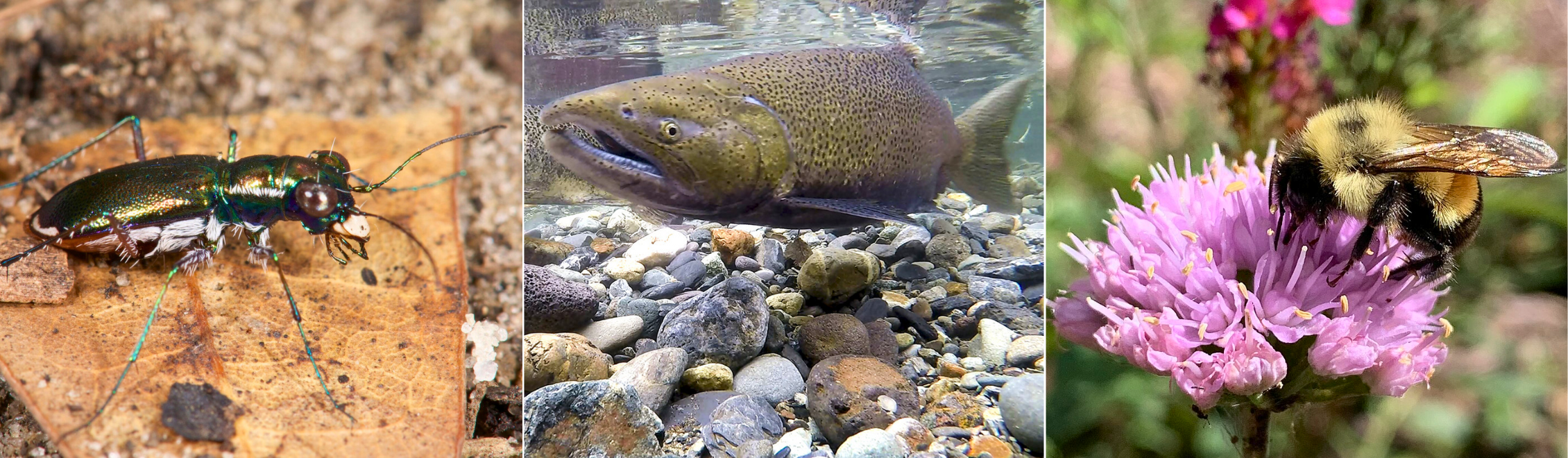
Since isocycloseram is an insecticide, it’s no surprise that it also harms other insects, including federally protected delta green ground beetles, valley elderberry longhorn beetles, Salt Creek tiger beetles. And it’s highly toxic to bees and other pollinators. The EPA has documented that vital pollinators could be exposed to 1,500 times the lethal level of isocycloseram just by collecting nectar and pollen near treated fields — including federally protected rusty patched bumblebees, El Segundo blue butterflies, Karner blue butterflies, and Poweshiek skipperlings.
The agency predicted that isocycloseram will have significant adverse effects on more than 1,000 other protected species protected under the U.S. Endangered Species Act.
What is cyclobutrifluram?
Cyclobutrifluram is a PFAS pesticide approved by the Environmental Protection Agency under the second Trump administration for use on golf courses, lawns, cotton, soybeans, and lettuce. It’s a newly created synthetic worm- and fungi-killer and is incredibly persistent, with a half-life of up to three years in soil and water. And cyclobutrifluram ultimately breaks down into TFA, with its likely half-life of several hundred years at least.
In humans cyclobutrifluram can increase the risk of cancer, particularly in the thyroid — a crucial part of our endocrine system.