|
Find any species in your region or state below and click on the link to help save them.
CALIFORNIA
Panamint Alligator Lizard: With its large, bony scales, large head on an elongated body, and powerful jaws, the Panamint alligator lizard lives up to its name by resembling a small alligator. This extremely rare lizard is found only in the desert mountains of Inyo and Mono counties in east-central California. Found near permanent water in canyons or in talus near dense vegetation, it has declined from a loss of riparian habitat due to mining operations, off-highway vehicles, grazing and the introduction of invasive species. Without Endangered Species Act protection, the lizard will continue to be threatened by these activities, especially from off-road vehicle enthusiasts exploring the Panamint Mountains. Take action for this species here.
Limestone Salamander: This salamander is at risk of extinction due to its extremely restricted range in small sections of the Merced River, near the main highway to Yosemite National Park. It lives in association with limestone on steep slopes, where the salamander uses its tail to assist in locomotion. It is threatened by gold mining, road building and quarrying for limestone.Take action for this species here.

Shasta Salamander: These 4-inch-long, dark reddish-brown salamanders, mottled with grayish green and tan specks, have webbed toes that allow them to climb sheer, slippery rock surfaces. The salamanders live only in California's Shasta County, in the headwaters of the Shasta Reservoir drainage. Their restricted range, coupled with the ongoing threat of habitat destruction and degradation, leaves them extremely vulnerable to extinction. These rare salamanders lay and brood their eggs in moist caves during the summer and crawl out into the open on rainy nights at other times of year. Many key salamander habitats were lost when they were submerged in Shasta Lake, after the construction of Shasta Dam. They continue to be threatened by proposals to raise Lake Shasta � which would further flood hundreds of acres of salamander habitat � as well as by timber management and recreational activities. Take action for this species here.
Lesser Slender Salamander (California): This salamander occupies relatively dry, high-elevation sites within its small range in the southern Santa Lucia Range of north-central San Luis Obispo County. Locally common about 25 years ago, the salamander is now almost impossible to find, driven toward extinction by road building and other development. The salamander's few remaining locations are on private land, where it�s wholly unprotected. The lesser salamander is the smallest of the slender salamanders, reaching just 1�2 inches long. It has a worm-like appearance with short limbs; a long, slender body; a narrow head and a long tail. Take action for this species here.
Inyo Mountains Salamander: In its extremely restricted range in the Inyo Mountains, the Inyo Mountains salamander relies on riparian vegetation surrounding small, permanent desert springs and seeps. These isolated mesic habitats are bordered by large expanses of inhospitable desert or semidesert terrain and are threatened by water diversion, mining activities and grazing. Because its range is less than 50 acres, the salamander is especially vulnerable to extreme weather events like flash floods that are expected to increase in frequency due to climate change. Like all slender salamanders � and unlike all other California salamanders � the Inyo Mountains salamander has just four toes on each hind foot instead of five. Take action for this species here.
Kern Plateau Salamander: This recently described salamander is endemic to the southeastern Sierra Nevada, including Tulare, Inyo and Kern counties. When handled, this tough little salamander tries to crawl away, coil or thrash, and sometimes produces a sticky skin secretion. Its reliance on springs makes it vulnerable to alterations of its spring water or habitat, including the capping of springs. The Kern Plateau salamander is also threatened by renewable-energy projects and suffers from road mortality. Take action for this species here.
Southern Rubber Boa: These nocturnal and secretive boas are vulnerable to extinction because of their very small range � which only includes the San Bernardino and San Jacinto mountains � coupled with ongoing threats of habitat destruction and degradation. This small constrictor has a stout body and smooth, shiny skin that has small scales, and is loose and wrinkled, giving it a rubbery look and feel. It prefers mixed conifer-oak forests with relatively open canopies. Rocks, logs and a well-developed layer of plant litter are key components of the boa's habitat, as they provide cover and maintain soil moisture. Found primarily on private lands, the rubber boa's habitat is threatened by the rapid pace of residential and commercial development. Even those boas found on public lands are threatened by Forest Service�permitted activities, such as forest thinning projects, off-road vehicle use, logging and firewood collecting. Take action for this species here.
WASHINGTON, OREGON
Cascade and Columbia Torrent Salamanders: These 4-inch, brown salamanders with bulbous eyes and bright-yellow bellies prefer cold, slow-moving mountain streams. Due in part to their extremely small lungs, even among salamanders, they are considered very intolerant of dry conditions, and as a result they occur primarily in older forest sites better able to maintain high moisture levels. Not surprisingly, timber harvest hurts them even more than it hurts many other amphibians, and the ongoing loss of their habitat through logging is well documented. The Cascade torrent salamander inhabits coniferous forests on the west slope of the Cascade Mountains, from southern Washington to central Oregon. The Columbia torrent salamander is found in coastal regions of northwestern Oregon and southwestern Washington. Take action for the Columbia torrent salamander here and the Cascade torrent salamander here.
VIRGINIA
Peaks of Otter Salamander (Virginia): Known to occupy only a 12-mile stretch of Virginia�s Blue Ridge Mountains, these darkly pigmented, 5-inch-long salamanders have one of the most restricted ranges of any salamander in the United States. These lungless amphibians never move more than a few feet from underground retreats located in the mature oak and maple forests of a single mountain ridge top. Because they cannot shift their range upslope as habitats become unsuitable in a warming climate, Peaks of Otter salamanders are particularly vulnerable to climate change. Take action for this species here.
SOUTHEAST
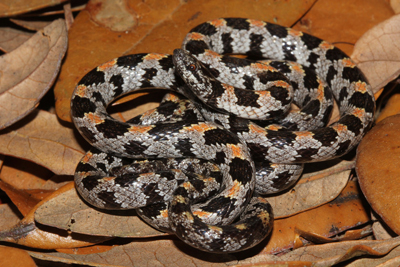
Short-tailed Snake (Florida): The short-tailed snake is a slender snake, about 1 to 2 feet long, with a beautiful pattern of black-and-yellow markings on its back. It is adapted to living underground and native to central Florida, where it is a state-designated threatened species. The short-tailed snake is rare, even within its narrow range, due to rapid habitat loss from urbanization and agriculture. Take action for this species here.
Florida Pine Snake (Florida, Alabama, Georgia, South Carolina): Reaching up to 5 feet long, the Florida pine snake is one of the largest snakes on the East Coast. People too often kill this snake out of fear, but it's nonvenomous and shy. A tan and reddish snake, it can climb trees but spends most of its time underground in the burrows of gopher tortoises or pocket gophers in dry, sandy soils. Due to habitat fragmentation and degradation, it is now lost from most places where it once lived in the Southeast. Take action for this species here.
NORTHEAST, MIDWEST
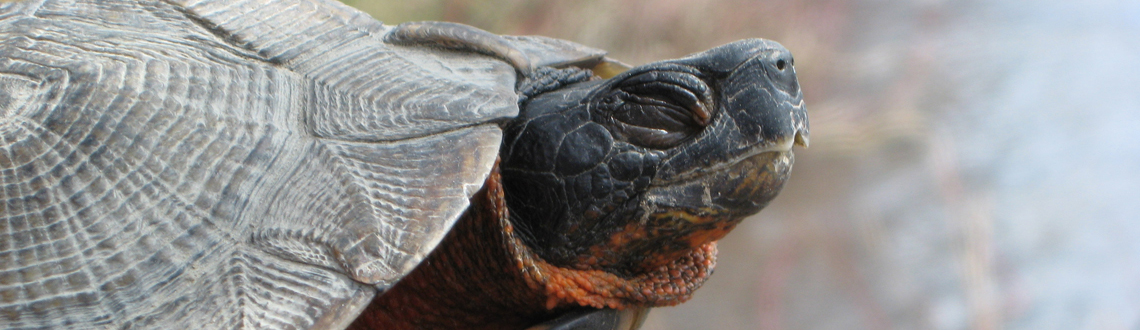
Wood Turtle (Connecticut, Iowa, Maryland, Maine, Massachusetts, Michigan, Minnesota, New Hampshire, New Jersey, New York, Ohio, Pennsylvania, Rhode Island, Vermont, Virginia, West Virginia, Wisconsin): The wood turtles� remaining populations tend to be isolated, hurt greatly by the pet trade; channelization of rivers and streams and careless timber-harvesting practices along waterways; and urbanization and agricultural practices, including pesticide use. These turtles have a greatly reduced chance of natural recovery in areas where their numbers have plummeted. Traditionally low survival rates among juvenile wood turtles have been made worse by the increased prevalence of turtle predators, such as raccoons and skunks, which thrive in urbanized areas. Wood turtles have an unusual feeding behavior: They stomp their front feet to cause earthworms to come to the surface.�Take action for this species here.
ARIZONA
Yuman Desert Fringe-toed Lizard (Arizona): These 5-inch-long cream, tan or reddish-brown lizards with relatively flat bodies and tails are limited to scattered areas of suitable habitat in southwestern Arizona and northwestern Sonora, south to Tepoca Bay. The lizard is restricted to sparsely vegetated, windblown sand dunes and sandy flats and is specialized for fragile aeolian sand habitats, requiring fine, loose sand for burrowing. Primarily an insect eater, the lizard will also occasionally eat other lizards as well as buds, leaves and flowers. Although found on a number of public lands, the lizard's habitat is still threatened in these areas by off-road vehicles. On private lands the lizard is faced with numerous threats, including commercial, residential and agricultural development. Take action for this species here.
TINIAN
Tinian Monarch (Tinian, a U.S. territory in the Commonwealth of Northern Mariana Islands): Members of the flycatcher family, monarch birds were first threatened with extinction during World War II due to forest clearing for agriculture and military staging on Tinian, a U.S. territory east of the Philippines and south of Japan. Since removal of its protections under the Endangered Species Act in 2004, a resurgence in military training activities and increased development have been threatening the birds� remaining forest. The monarch is a 7.5-inch, tan-faced bird with a gray head, chocolate-brown back, and dark wings with white bars. It feeds by catching insects and nests year-round in trees, with reduced nesting during periods of low rainfall. The monarch�s call sounds like a squeaky dog toy. Take action for this species here.
CALIFORNIA, OREGON, WASHINGTON, NEVADA
Tricolored Blackbird: More than 99 percent of tricoloreds live in California, where the primary breeding range is the Sacramento and San Joaquin valleys. Adult males are a glossy blue-black with striking red and white shoulder patches, while females are mostly black with a small reddish shoulder patch. Tricoloreds form the largest breeding colonies of any North American land bird, with a single colony often consisting of tens of thousands of birds as a defense against predation. Forced from their natural nesting sites by conversion of wetlands and native grasslands to urban and agricultural development, many tricoloreds have adapted by nesting in agricultural crops � typically dairy silage fields, where harvest destroys nests and kills chicks. Take action for this species here.
UTAH
Virgin River Spinedace: This medium-sized, silvery minnow has a brassy sheen and black speckles, and it develops orange, red and gold patches during the breeding season. The fin on its back has eight rays, the first two of which are hard, spiny and weakly fused, which gives the spinedace its name. There are only four species in the spinedace genus. One of them, the Pahranagat spinedace, is extinct, and the other three are at risk of extinction. The Virgin River spinedace was once common throughout the Virgin River basin in northwestern Arizona, southeastern Nevada and southwestern Utah, but it has lost more than half its range to dropping river levels caused by increased withdrawals, pollution and streamside habitat destruction. Take action for this species here.