Saving western spadefoots
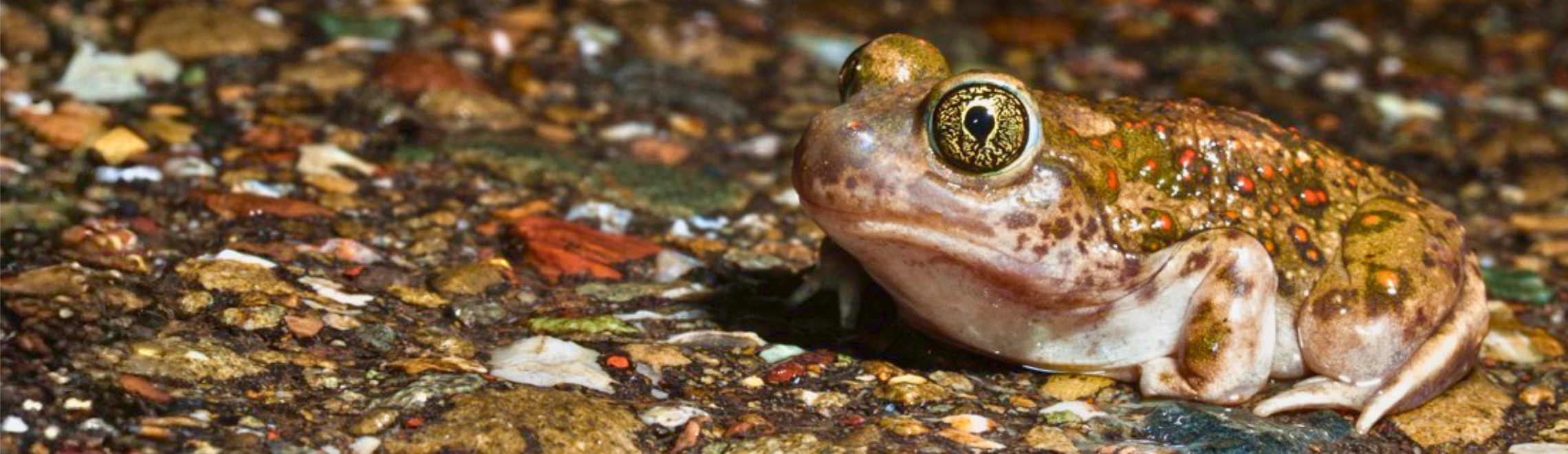
Western spadefoots are small, cryptic amphibians named for the black, wedge-shaped spades on their hind feet, which they use to dig. They’re also known for their big, gold cat-like eyes — whose irises are vertical ovals in bright light but large and round in the dark.
This species was once common throughout much of California, but its populations have been in steep decline for decades, especially in Southern California, due to habitat loss, degradation, and fragmentation — along with threats from climate change, pollution, and invasive species.
Status and Threats
Are western spadefoots at risk of extinction?
Yes. Western spadefoot populations throughout California have lost vast amounts of habitat and become highly fragmented. In super developed areas like Orange County, they’ve been shown to exhibit very small “effective population sizes” — scientific calculations that help predict genetic health and evolutionary potential. That means they’re extremely vulnerable to extinction.
What are they threatened by?
Habitat destruction and fragmentation are the most severe threats to western spadefoots — especially in Southern California, where the loss of their home turf is particularly severe due to rampant development.
To survive, western spadefoots need high-quality grasslands or shrublands that contain seasonal breeding pools. They can breed in different types of water bodies but are particularly reliant on vernal pools, a unique type of seasonal wetland. Vernal pools support incredible biodiversity, including multiple plant and animal species found nowhere else on Earth.
California has lost up to 95% of its historic vernal pools. Those that remain are under significant development pressure and have limited protection.
Western spadefoots are well adapted to California’s Mediterranean-type climate, which typically has warm, dry summers and cool, wet winters. But extreme droughts and shifts in precipitation present new challenges.
These spadefoots are also threatened by pollution — like from pesticides in agricultural runoff contaminating their breeding pools — and invasive species, including American bullfrogs, crayfish, nonnative fish, and other aquatic predators who eat spadefoot larvae and compete with spadefoots for resources, severely reducing survival rates.
Our Campaign
What’s the Center doing to save western spadefoots?
These embattled amphibians currently have no state or federal species-specific protections — and we’re working to change that.
Following a Center petition, in 2023 the U.S. Fish and Wildlife Service proposed western spadefoots for listing as a threatened species under the federal Endangered Species Act — but the agency never made a final decision. The Trump administration’s efforts to weaken environmental protections, including the Act, make it unlikely that this species will get federal protection anytime soon. Changes to weaken the Clean Water Act also make semi-aquatic species like this one particularly vulnerable.
So the Center has petitioned the California Fish and Game Commission to protect western spadefoots under the state Endangered Species Act. The petition seeks to recognize western spadefoots in Southern California as an endangered species and those in Northern California as a threatened species. State protection would require local authorities to work with state wildlife experts and agencies to address the threats to their existence.
In 2026 the commission voted to make spadefoots a candidate species, temporarily protecting them while triggering a year-long review by the California Department of Fish and Wildlife to determine if the northern and southern populations should be permanently protected under the state Act.
We also work in and out of court to fight sprawl development that threatens western spadefoot habitat.
Check out our press releases to learn more about the Center's actions to save western spadefoots.
Natural History
Western spadefoot } Spea hammondii
Family: Scaphiopodidae
Are spadefoots toads?
Nope. Spadefoots are a type of frog. They’re sometimes casually called “spadefoot toads” because of their pudgy bodies and digging habits, but they’re not true toads because they’re not members of the Bufonidae family, and they lack true toads’ characteristic toxin-secreting parotid glands (found on the sides of toads’ heads).
You may have read that spadefoots aren’t “true frogs” either, which is correct — but they’re still a type of frog. It’s all in the taxonomy: “True frogs” refers to frogs in the family Ranidae, which spadefoots aren’t. But all species within the order Aruna are frogs, which means all families of frogs and toads — including spadefoots — are kinds of frogs.
In addition to western spadefoots, there are two other spadefoot species in California: Great Basin spadefoots (Spea intermontana) and Couch’s spadefoots (Scaphiopus couchii).
What do they look like?
These frogs are small and chubby, reaching only about 1.5 inches to 2.5 inches in length. They have relatively smooth, olive-brown or gray skin with small reddish or orange bumps called “tubercles”; a white belly; and big, gold eyes with vertical irises (that turn large and round in the dark). They’re named for the black, shovel-like “spades” on their hind feet, made of keratin and used for digging.
What’s their habitat?
Western spadefoots can be found in grasslands and shrublands, spending most of their lives in underground burrows and staying in a dormant state during dry seasons. After it rains, they emerge to forage and breed. They primarily breed in vernal pools — temporary wetlands that fill with water in winter and spring, drying out by summer — but they can also use intermittent streams, reservoirs, irrigation ditches, and even water-filled road ruts. They range from Central California to Baja California, Mexico.
What do they eat?
Adult western spadefoots are nocturnal, preferring to hunt at night during the rainy season. They prey on various invertebrates, including terrestrial arthropods, beetles, moths, crickets, true bugs, flies, and earthworms. Tadpoles feed mainly on plants and planktonic organisms, algae, ants, small invertebrates, and dead aquatic larvae of other amphibians.
What’s their life cycle like?
Western spadefoots breed from winter to spring, when males can be heard making their distinctive, snore-like mating call. Females lay numerous small, irregular chains of about 10-40 jelly-covered eggs that attach to objects in the water. In an act called “amplexus,” males grasp females with their front legs, depositing sperm on the eggs as the females release them, fertilizing the eggs externally. Tadpoles hatch within a few days — sometimes in just 15 hours — after which their survival depends on them developing into froglets before their pools dry up. Western spadefoot tadpoles develop into froglets within three weeks to three months, depending on climatic conditions.
On average these frogs are thought to live about 5-6 years, reaching sexual maturity in their first or second year.
What are some other cool facts about western spadefoots?
- The males’ mating call sounds hoarse, like a snore.
- On a calm night, a group of calling males can be heard up to a mile away.
- Adult frogs produce unpalatable, sticky skin secretions to ward off predators, who include American bullfrogs, garter snakes, and raccoons.
- Western spadefoot tadpoles have one of the fastest recorded metamorphoses of any frog or toad species.