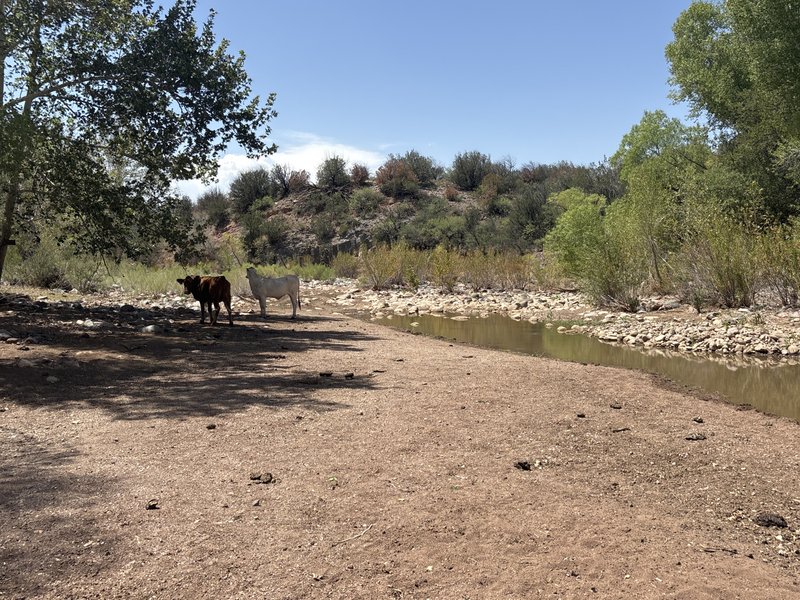
PHOENIX— The Center for Biological Diversity and Maricopa Bird Alliance sued the U.S. Forest Service and U.S. Fish and Wildlife Service today for allowing illegal cattle grazing to destroy protected streams and riparian areas in Arizona’s Tonto National Forest. The forest provides critical habitat for many endangered species, including birds, snakes and fish.
“We won’t tolerate destruction of Arizona’s precious desert riparian habitats, so we’re going to court to protect them,” said Center co-founder and board member Robin Silver. “Illegal grazing is decimating streams and endangered species habitat on the public’s land, and it must end. Federal agencies must obey the law and remove cows from these places now.”
Surveys conducted by the Center in 2025 found moderate to significant damage from cattle grazing along 55% of 122 miles of waterways across 25 grazing allotments named in today’s lawsuit. By destroying vegetation, crushing stream banks, and polluting water with urine and feces, cattle have damaged habitat for yellow-billed cuckoos, Southwestern willow flycatchers, Chiricahua leopard frogs, northern Mexican garter snakes, narrow-headed garter snakes, spikedace, razorback suckers and Gila chub.
Grazing damage occurred on allotments leased by 21 ranching operations. From 1995 to 2024 those operations received $8.3 million in federal and state subsidies — an average of $394,520 each — according to data from the Environmental Working Group and the Arizona Grazing Clearinghouse. These figures do not include the reduced federal grazing fees paid by the ranchers.
“The public loses twice when the same livestock operations that are allowed to trash endangered species habitat also receive deep public subsidies,” said Silver. “The industry’s awash in subsidies, and it’s an obscene use of public money and public land.”
Damaging cattle grazing has persisted despite a U.S. Department of Justice attorney telling a federal judge that “[i]t's well settled that cattle and riparian areas do not mix” and the Forest Service stating “[r]ivers and streambeds are conduits for life… Protection and enhancement of riparian and aquatic areas is paramount in providing habitat and sustainable water for dependent fish, wildlife, plant species, and human communities alike.”
“We cannot stand by and watch the ongoing destruction of Arizona’s desert riparian habitats,” said Maricopa Bird Alliance conservation chair Charles Babbitt. “The grazing abuse that has been carefully and repeatedly documented must stop.”
Roughly three-fourths of Arizona’s wildlife species depend on riparian areas to survive even though these streamside habitats represent only 0.5% of the state’s total land area. Removing banned cows from riparian areas is critical to curbing the extinction crisis in the Southwest.
Ranching on public lands in Arizona accounts for just 1.2% of total U.S. beef production, yet remains the most widespread commercial use of public lands and a leading cause of biodiversity loss in the arid West.
Today’s lawsuit, filed in U.S. District Court in Phoenix, says the federal agencies violated the Endangered Species Act by failing to protect threatened and endangered plants and animals, and their critical habitat, from cattle grazing in the national forest. Critical habitat is designated under the Endangered Species Act to provide for the survival and recovery of endangered species.
Eubanks and Associates are representing the Center and Maricopa Bird Alliance in this lawsuit.